
 By Debbie Duel
It’s no secret that there are far more cats and dogs than there are veterinarians—or affordable options to fix them. At Rowan University’s new Shreiber School of Veterinary Medicine in New Jersey, Dr. Kirsten White is helping shape the next generation of veterinarians ready to take on that challenge.
A New Jersey native, Dr. White spent a decade as a veterinary technician before earning her DVM and completing shelter medicine training at the University of Florida. After working in both general and corporate practice, she returned to her true calling—community medicine—spending eight years at one of People for Animals, Inc.’s three high-volume, low-cost clinics in New Jersey. There, she saw firsthand how affordable, accessible spay/neuter programs can transform the lives of both animals and people.
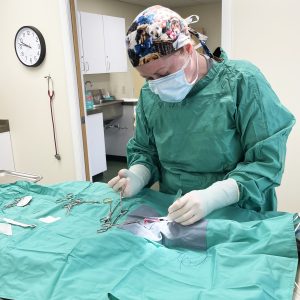
Now, as Clinical Assistant Professor and Section Head of Shelter Medicine & Community Engagement at the Shreiber School, Dr. White brings her frontline experience to the classroom, exam room, and surgery suite—guiding students through hands-on learning. “Learning isn’t just about lectures; it is important to experience and do things in the clinical settings like the surgery suite,” she says.
The Shreiber School of Veterinary Medicine, which welcomed the Class of 2029 in September and opened its teaching hospital shortly thereafter, is addressing pet overpopulation through an innovative, community-focused curriculum that empowers future veterinarians to reduce shelter intake and improve animal welfare. Many students entering the school are already aware of the importance of spaying and neutering, having volunteered in shelters and witnessed the consequences of limited access to preventive care.
One of them is Kristianne Casale, a 2025 Aquinas College graduate who brings passion, experience, and curiosity to the school’s inaugural class. At the Niagara County SPCA, she worked as a kennel attendant, veterinary assistant, and manager of the medical department. Kristianne, however, credits her mother for sparking her lifelong commitment to population control. “My mother participated in TNVR programs for almost 20 years and started her own in 2013,” she says. “She exposed me to spay/neuter surgeries from an early age and taught me the importance of population and disease control among feral cats.”
As a longtime spay/neuter advocate, Kristianne was drawn to the Shreiber School’s emphasis on community medicine. “The Shreiber School of Veterinary Medicine’s concentration on shelter medicine and One Health absolutely influenced my decision to enroll,” she explains. “My experiences gave me insight into the interconnectedness of animal, human, and environmental health, and I was excited to learn how much the school focuses on these principles. The school’s dedication to community engagement allows me to deepen my passion for providing veterinary care to pets from all walks of life.”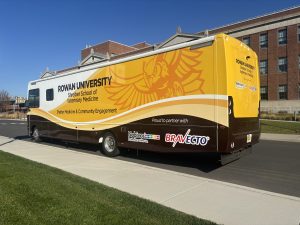
During their final, fully clinical year, students at New Jersey’s first veterinary school return to familiar shelter settings. Under faculty supervision, they manage primary cases and gain real-world experience in patient care. Every student participates in the core Shelter Medicine and Community Engagement Clerkship, “serving local communities by caring for adoptable animals and cherished pets facing the same barriers to healthcare as their human family members,” says Dr. White.
Dr. White reminds her students that pet overpopulation affects every community—and that “whether their patients are beloved pets or shelter animals waiting for adoption, the animals in the community are everyone’s responsibility.” Strong community medicine programs, she emphasizes, benefit everyone. Her goal is to inspire students to approach their work with one guiding question: How can I help here?
The Shreiber School of Veterinary Medicine’s engagement efforts include partnerships with human service organizations to provide companion animal care, free clinics for individuals facing housing or food insecurity, and mobile units that support shelters without on-site veterinarians. These initiatives deliver wellness care and spay/neuter assistance where it’s needed most. Sterilizing animals before adoption, Dr. White notes, is one of the simplest, most effective ways to reduce pet overpopulation. The school’s work will increase the number of timely surgeries and shorten shelter stays for countless animals.
“I would love to build working relationships with local shelters and other organizations to promote spay/neuter awareness and preventive medicine,” says Kristianne. “My goal is for my career to reflect compassion and the belief that every animal deserves access to care—and every owner deserves options for their pet, regardless of financial situation.”
The Shreiber School’s community-centered training is a win-win for veterinary students, the community, and, above all, the animals.
For more information, contact:
Shreiber School of Veterinary Medicine of Rowan University
1000 Gilbreth Parkway
Harrison Township, NJ 08062
General Inquiries to the Veterinary Teaching Hospital
ssvminfo@rowan.edu