The First Duty: Why Spay/Neuter Belongs at the Beginning, Not the End
April 13, 2026
If you’ve spent any time in the animal welfare world, you’ve heard the debates: no-kill versus open-admission, managed intake versus open doors, socially conscious sheltering versus traditional models. The terminology shifts. The frameworks multiply. The animals keep coming.
That’s exactly the problem at the center of a new essay, “The Tenth Tenet: Why No-Kill and Socially Conscious Sheltering Keep Failing,” published this month on the Animal Politics Substack by former shelter director Ed Boks. And at the heart of his argument is a name we know well: Esther Mechler.
The essay’s title calls it a “Tenth Tenet,” but that framing undersells the argument. Boks isn’t proposing an addendum. He’s proposing a foundation.
His point is that targeted, high-quality, high-volume spay/neuter (HQHVSN) shouldn’t be the last item on a list of humane sheltering principles — something to get to once the other nine are in place. It should be the first; the thing that makes everything else more achievable.
Prevention isn’t a program that runs alongside the sheltering mission. It is the mission, upstream of everything else.
That distinction matters more than it might seem. When prevention is framed as one tenet among ten, it’s easy to treat it as optional, underfunded, or deprioritized when capacity gets tight. When it’s understood as the first principle — the thing without which the rest of the framework is always playing catch-up — it becomes harder to push aside.
Photo by Animal Politics with Ed Boks
The Missing Piece
The essay focuses on Socially Conscious Sheltering (SCS), a nine-tenet framework introduced in 2019 to move animal sheltering beyond both reflexive euthanasia and slogan-driven absolutism. It’s a thoughtful framework, but the argument is that it underemphasizes spay/neuter, treating it as implied rather than naming it as a foundational obligation.
And where did the idea for naming this omission originate?
From Esther.
As Boks writes, the concept came from “Esther Mechler, a longtime spay/neuter pioneer who founded Marian’s Dream and later United Spay Alliance, both dedicated to reducing companion-animal overpopulation through prevention. Her work has shaped prevention-based animal welfare thinking for decades.”
He continues: “In urging that this new framework add one more tenet, and doing so when it was still in its infancy, Mechler put her finger on a quiet but consequential omission: a sheltering philosophy may be compassionate, practical, and ethically serious, yet still fail to name the one intervention most likely to reduce intake, suffering, and killing at the source.”
Her insight was as simple as it was profound: if prevention isn’t embedded in the framework itself, it will keep being treated as peripheral to the mission rather than central to it.
Going Upstream: The Babies in the River
There’s an old parable that gets at why this matters so much.
A village elder is walking along a riverbank when she spots a baby floating downstream, struggling in the current. She dives in and pulls the child to safety. Before she can catch her breath, another baby appears. Then another. She calls for help, and soon the whole village is in the river, pulling babies to shore as fast as they can — exhausted, overwhelmed, barely keeping up.
Finally, one villager starts walking upstream. “Where are you going?” the others shout. “We need you here!”
“I’m going to find out who’s throwing the babies in,” she says.
This is where animal welfare has been for a long time: so consumed by the babies already in the river — the animals already surrendered, already homeless, already in crisis — that going upstream can feel irresponsible, even selfish. And the resistance is real. We can’t abandon the animals in front of us. This approach is too risky. It won’t move fast enough. And frankly — what would we do differently?
But until someone goes upstream, there will always be more babies in the river than we have the capacity to save. The most dedicated shelter staff, the most sophisticated placement programs, the most compassionate triage protocols — none of it resolves a crisis that is being continuously replenished at the source.
Spay/neuter is going upstream. It is the intervention that happens before the surrender, before the intake, before the impossible choices. And it is precisely because it happens before — invisibly, in communities, in veterinary clinics, in low-income neighborhoods where access has historically been hardest to reach — that it has so often been treated as background work rather than the central mission it actually is.
Prevention Is Not a Side Program
The essay traces how the remarkable decline in shelter euthanasia in the late twentieth century wasn’t driven by smarter placement programs or more sophisticated shelter philosophy. It happened, in large part, because sterilization became more available, more affordable, and more widely accepted.
Prevention worked. Then, gradually, the field shifted its gaze downstream — toward live release rates, transport programs, and capacity metrics — and spay/neuter receded from center stage.
The consequences are visible in overwhelmed shelters across the country today.
As the essay puts it plainly: shelters cannot save their way out of an overpopulation crisis they are unwilling to prevent.
That’s not a criticism of the dedicated people working in shelters. It’s a call for the field’s frameworks — its philosophies, its tenets, its measurement systems — to reflect what we actually know about where animal suffering begins.
What This Looks Like in Practice
A genuine commitment to prevention means more than endorsing spay/neuter in the abstract. It means:
Making sterilization affordable and geographically accessible, especially in underserved communities
Prioritizing the neighborhoods generating the highest shelter intake
Embracing HQHVSN as the standard of care, not a boutique option
Supporting spay/neuter for cats by five months of age as routine practice
Treating access to spay/neuter services as part of the sheltering mission, not separate from it
Sound familiar? It should. This is the work United Spay Alliance and our network of state and local partners do every day — through HQHVSN wet lab trainings, our nationwide low-cost spay/neuter directory, the Feline Fix by Five campaign, and our State Leader Network connecting advocates across the country.
We are, to put it simply, the people who went upstream. And we’ve always known that’s where the work has to start.
Read the Full Essay — and Share It
The Tenth Tenet essay is a thought-provoking read for anyone working in sheltering, veterinary medicine, rescue, advocacy, or community outreach. We don’t agree with every framing, and the broader conversation it’s part of is one the field is still working through. But the core argument — that prevention belongs at the center of any serious humane sheltering philosophy, and that it belongs there first — is one we’ve staked our mission on.


 If you’ve spent any time in the animal welfare world, you’ve heard the debates: no-kill versus open-admission, managed intake versus open doors, socially conscious sheltering versus traditional models. The terminology shifts. The frameworks multiply. The animals keep coming.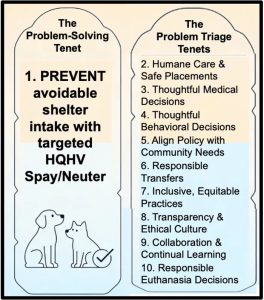
 Prevention Is Not a Side Program