The More the Merrier! HQHVSN Training in PA
By: Brianna Lovell Myers, Administrative Director at United Spay Alliance


By: Brianna Lovell Myers, Administrative Director at United Spay Alliance

Spay/neuter is at a crisis point in the United States. The reality is that there just aren’t enough appointments available to meet the overwhelming demand for services.
To meet the moment, it is more important than ever to have as many veterinarians trained in high-quality, high-volume spay/neuter (HQHVSN) techniques as possible. HQHVSN surgeries are more efficient; incisions are smaller, surgery times are shorter, recoveries are faster. HQHVSN is better not only for veterinarians and their teams, but for the individual animal as well. HQHVSN is a best practice, regardless of whether surgeries are performed in a high-volume clinic or private practice setting.
That’s why we’re so excited to see even more training opportunities available! While USA is working to facilitate our own HQHVSN wet labs and develop training templates for more communities to follow, we are also excited to see other training opportunities available. Like the free HQHVSN training offered by our State Leader in Pennsylvania, Dr. Becky Morrow and Frankie’s Friends.
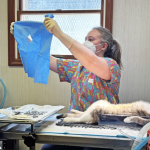

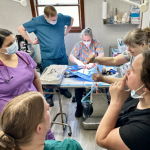
Nearly 200 veterinary students and practitioners observed over four hours of surgery, gaining valuable insights into HQHVSN techniques.
The training was spearheaded by Dra. Blayra Maldonado, a professor at Universidad de Sonora, a veterinarian with Animal Home, and the Director of Academics & Medical Director for Spay Mexico. The event was supported by Spay Mexico, GuaGua, Animal Home, Universidad de Sonora, and UVM. Special thanks go to Dr. Andres Ochoa, head of the Department of Agriculture & Livestock at Universidad de Sonora, for his role in facilitating this opportunity.
Universidad de Sonora also offers veterinary students a 27-hour online course titled, “One Health: A Comprehensive Approach to Controlling Canine and Feline Overpopulation” every year.
Bringing HQHVSN directly into the veterinary curriculum at universities has already produced some outstanding results for Mexico. We are eager to see what’s next in the evolution of spay/neuter training for Spay Mexico, and the entire Spay Global team.